Jamarques Hudson

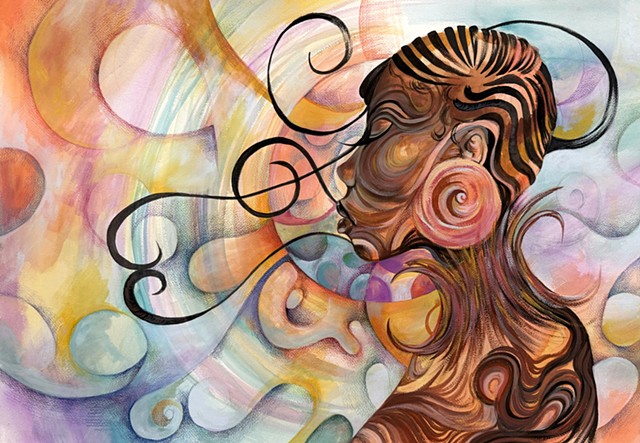
I create drawings that exist within realms of spirituality and mysticism, portraying Black figures in a state of divinity. These figures represent the African diaspora, functioning as archetypal beings that carry the presence of multiple histories and identities rather than specific individuals. Using Halo like forms, elongated anatomy, and surreal use of color, I push beyond realism creating a space that is surreal that is more focused on the eternal self. Hair and adornment extend outward, becoming active forms of energy and symbolism, transforming each figure into a vessel of memory and presence.

My work is rooted in my upbringing within a matriarchal household shaped by the absence of a father. I was raised by a collective of strong women whose influence formed not only the man I am today, but the artist as well. Through them, I learned emotional sensitivity, care, and attentiveness, values that remain central to both my life and my practice. This foundation informs how and why I depict Black women as anchors and vessels of identity. Influenced by artists such as Chris Ofili, Harmonia Rosales, and Toyin Ojih Odutola, alongside Renaissance painters like Sandro Botticelli, my work merges classical religious portraiture with contemporary Black figuration. Inspired by my interest in art history I reimagine traditional depiction of figures through a diasporic lens, subverting the content in a way that envision the African diaspora beyond historical limitation, shaping figures that embody divinity, power, and autonomy.

My process is intuitive and responsive. Working with materials such as gouaches and colored pencils, I balance abstraction with control. Gouache allows for fluidity and atmospheric layering, while colored pencils help refine form and guide the narrative. I build each drawing through layered marks, responding in the moment and allowing the work to unfold naturally. Drawing becomes a spiritual act of listening as much as creating, guided by emotion and a sense of ancestral presence.

Focusing on Black figurative work is important to me because it allows space to create new narratives around the Black experience beyond definition. Rooted in my own emotional depth and spirituality, my work is a way for me to continue learning about myself as a Black artist. Building from the hard work of Black artists who came before me, I use my practice to push and expand what it means to be Black.